
Not sure what your dog’s coat needs? Start here.
Six quick questions suggest a coat group and explain common shedding patterns. A useful starting point before buying another brush. No email is needed to see your result.

A gentle starting check, not a final answer
- Only if your dog is comfortable, gently part a small area of coat at the shoulder or side.
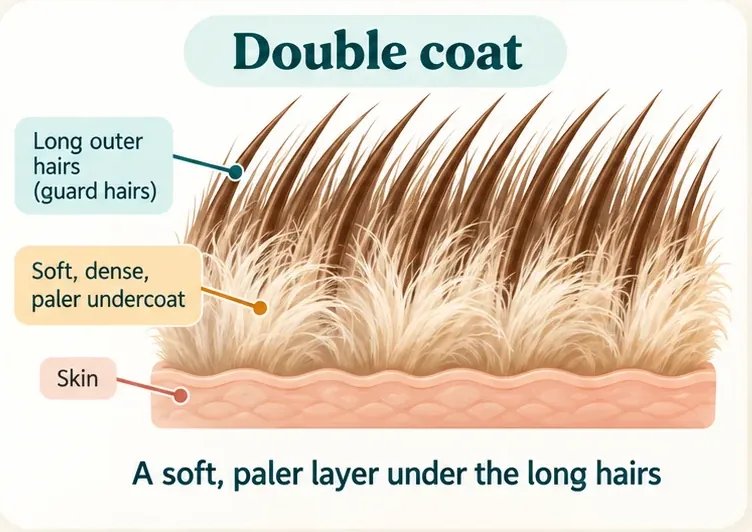
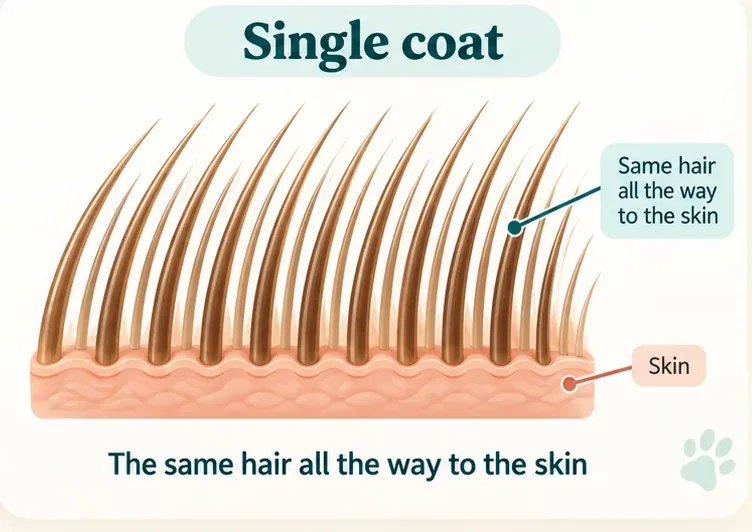
- Look for a softer layer beneath the outer hairs. Do not pull tufts or keep brushing to test the coat.
- A visible undercoat is a clue. Not seeing one does not prove it is absent. Ask a knowledgeable groomer when unclear.
- Your dog’s coat group, in plain English
- General shedding patterns, without a promised start or finish date
- What to keep an eye on for your dog’s coat type
Not next to your dog right now? Answer from memory. This quiz is for learning, not a substitute for advice from a vet or groomer.
Want a copy in your inbox?
Your result appears on this page. You can print it for your own reference.
How to tell if your dog has a double coat
A double coat has two layers. The long outer hairs, called guard hairs, protect against water and dirt. Underneath is a soft, dense undercoat that insulates. Many double-coated dogs shed more heavily in spring and fall, while also shedding at other times. The pattern varies by dog and environment.
Look gently and allow an uncertain result
Part a small area only where handling is comfortable. Age, season, clipping and mixed-coat characteristics can make the layers hard to distinguish. Stop if your dog is uncomfortable. A quick home check does not establish the safest tool or diagnose hair loss.
The five coat groups
These broad groups help organize this site’s guidance. Breed examples are clues, not a diagnosis or a guarantee of coat type. Mixed coats can be difficult to classify; ask a qualified groomer if you are unsure.
| Group | Breed examples | What you’re dealing with |
|---|---|---|
| Short double | Labrador Retriever, Greater Swiss Mountain Dog, Cardigan and Pembroke Welsh Corgi | Short hair may carry dense undercoat. Shedding timing varies by dog. |
| Medium double | Border Collie, Australian Shepherd | Length and feathering vary. Check for tangles gently. |
| Long double | Newfoundland, Bernese Mountain Dog, Great Pyrenees, Saint Bernard | Volume. Mats form out of sight, close to the skin. |
| Dense / arctic double | Pomeranian, Samoyed, American Eskimo Dog, Alaskan Malamute | A dense coat that may need an individual grooming routine. |
| Single or curly | Poodle, Maltese, Greyhound, Whippet | Care needs differ. Curly coats can retain shed hair; smooth coats also shed. |
- Short double
- Breed examples: Labrador Retriever, Greater Swiss Mountain Dog, Cardigan and Pembroke Welsh Corgi
- Coat care: Short hair may carry dense undercoat. Shedding timing varies by dog.
- Medium double
- Breed examples: Border Collie, Australian Shepherd
- Coat care: Length and feathering vary. Check for tangles gently.
- Long double
- Breed examples: Newfoundland, Bernese Mountain Dog, Great Pyrenees, Saint Bernard
- Coat care: Volume. Mats form out of sight, close to the skin.
- Dense / arctic double
- Breed examples: Pomeranian, Samoyed, American Eskimo Dog, Alaskan Malamute
- Coat care: A dense coat that may need an individual grooming routine.
- Single or curly
- Breed examples: Poodle, Maltese, Greyhound, Whippet
- Coat care: Care needs differ. Curly coats can retain shed hair; smooth coats also shed.
If your dog is between two groups
Treat the quiz as a starting point. Ask a qualified groomer to check the coat before choosing a tool or schedule; the longer-looking coat is not automatically the safer choice.

Written by Michael Northcutt, Certified Companion Animal Rehabilitation Therapist, credentialed through the NC State University College of Veterinary Medicine. The groups are broad categories used by this guide. Not a vet, and nothing here is veterinary advice.
Coat questions people ask
Further reading: AKC on managing shedding and VCA on seasonal hair loss and diagnosis. These sources do not endorse the quiz.
How do I know if my dog has a double coat?
A softer layer beneath the outer hairs can suggest undercoat. Not seeing one does not prove it is absent. Gently part a small area only if handling is comfortable, and ask a knowledgeable groomer if uncertain. Do not pull tufts to test it.
Should I shave my double-coated dog in summer?
Do not shave a double coat simply because the weather is hot. Ask your vet or a qualified groomer before clipping; medical needs or severe matting can change the advice for an individual dog.
When do double-coated dogs shed the most?
Many double-coated dogs shed more heavily in spring and fall. Indoor living and individual differences can change the pattern. Duration varies; a quiz cannot predict an exact start or finish date.
Can heavy shedding be a sign of a problem?
Contact your vet about new patchy or bald areas, a sudden change in shedding, or itching, redness, sores, pain, or a bad smell. Skin can look comfortable even when hair loss has a medical cause.