
Enrichment · Toys that fit
Dog Enrichment Toys: Stop Buying Ones Your Dog Ignores
Quick answer: pick the toy by what your dog loves to do. Sniffers get foraging toys, lickers get lick mats, chewers get tough rubber.
Start every new toy almost too easy, stay close, and put it away when the food is gone.
Heads up: we sell the Vet Prep Pack mentioned here.
You bought the toy because you wanted your dog to have more mental stimulation. Then came the basket.
You know the one. The puzzle your dog flipped once. The snuffle mat with a hole in it. The ball living under the couch.
Each one promised a busy, happy dog. Most got a sniff and a shrug.
That’s rarely your dog’s fault, or yours. The toy just didn’t match how your dog likes to work.
This guide sorts enrichment toys by the job they give your dog. Then it shows you how to start easy, so the next one gets used.
Who this is for: owners shopping for enrichment toys who would rather buy once than five times.
It helps most if your dog gets bored indoors, eats too fast, or ignores the toys you already own.
Our pick for sniffers and lickers: a snuffle mat and a lick mat. Not for shredders.
What are the best enrichment toys for dogs?
The best one matches what your dog already loves doing. Notice whether your dog leads with its nose, tongue, jaws or paws.
Dog enrichment toys are interactive toys that give your dog a job, like sniffing, licking, chewing or solving for food.
The ASPCA names the natural behaviors enrichment should tap: playing, chasing, smelling, chewing and scavenging.
Dogs who don’t get that outlet tend to find their own, the ASPCA adds. That usually means unwanted behavior.
So spend one day watching what your dog does for fun. Then match it to a type below.
| Type | Your dog’s job | Great for | Think twice if |
|---|---|---|---|
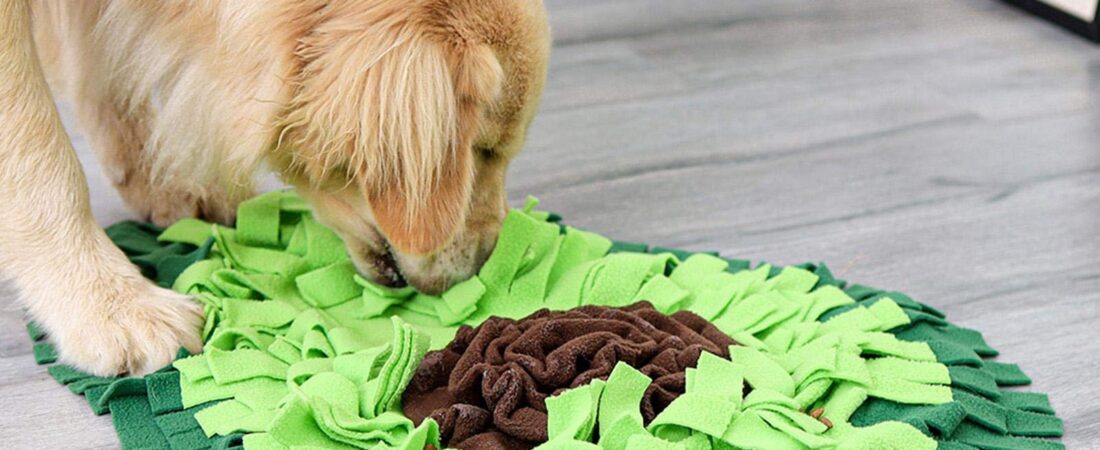
| Foraging: snuffle mat, scatter feeding | Sniff out kibble hidden in fabric strips or grass. | Fast eaters who need a slow feeder, keen sniffers, rainy days. | Your dog shreds fabric toys. |
| Licking: lick mat, Kong-style stuffable toy | Lick a thin spread out of grooves or a hollow toy. | Dogs who settle while licking, and wind-down moments. | Your dog chews silicone or flips the mat. |
| Chewing: durable hard rubber toys, chews | Gnaw on something made for gnawing. | Dogs with a strong need to chew. | It starts breaking into pieces. |
| Puzzles: sliders, flaps, treat dispensers, wobble balls | Push, flip, roll or slide parts to release food. | Food-driven problem solvers. | Your dog chews plastic or pulls out loose parts. |
| Scent games: find it, box search, beginner nosework | Search a room for hidden treats. | Any dog with a nose, and no budget needed. | You make it hard too soon. |
Not sure where to start? Try foraging or a scent game. Most dogs can sniff, and an old towel costs nothing to test.
A useful next step
Check the food before you fill the mat
Our free food checker gives separate dog and cat answers, preparation cautions and source links. Results appear without an email address.
What are the most mentally stimulating things for dogs?
Sniffing is a great place to start. It can be stimulating and calming, the ASPCA says, and it helps dogs learn about their surroundings.
That’s why foraging toys show up on so many lists. A snuffle mat turns a handful of kibble into a real search.
Puzzle toys add problem solving. The simplest ones just need pushing around, Whole Dog Journal notes.
Harder puzzles ask your dog to push buttons, pull drawers, open flaps or nudge sliders.
Licking works differently. Whole Dog Journal calls licking a calming behavior for dogs. Lick mats get sold as calming toys, but think wind-down, not treatment.
Many puzzle lines come in levels. Start with a lower level and move up once your dog gets the hang of it.
Mixing types keeps things fresh. Whole Dog Journal suggests owning two or three puzzles and rotating them.
What are some good enrichment ideas for dogs?
Start with free ones from your kitchen and recycling bin. They show you what your dog enjoys before you spend anything.
- Muffin tin game. Put kibble in the cups and leave them open at first, as AKC suggests. Then cover each cup with a tennis ball.
- Towel roll. Sprinkle treats on an old towel, roll it up, and tie it in a knot.
- Paper roll puzzle. Fold one end of a toilet paper tube, drop in treats, then fold the other end.
- Shoebox search. Set out a few boxes and bait one with smelly treats. Poke holes in the lids to make it easier.
- Scatter feeding. Toss a handful of kibble on the grass or a patterned rug, and let your dog hunt.
- Frozen bowl. Add water or dog-safe broth to food in a normal bowl, then freeze it.
Cardboard tears apart easily, so watch closely. AKC says to make sure your dog doesn’t eat the bits.
Use the results. Loved the muffin tin? Try a puzzle toy next. Loved the towel roll? A snuffle mat is the washable version.
What should you look for in an enrichment toy?
The right size, no parts to chew off, easy cleaning, and a level your dog can win at.
- Size that fits your dog. Pick a toy too big to swallow. Large dogs clear small mats fast, so tuck food deep.
- Durable enough for your dog. Tough chewers need hard rubber, not fabric or thin plastic.
- A shape your dog can reach. Flat-faced dogs like pugs may find deep puzzles awkward. Shallow puzzles and flat mats are easier.
- No loose bits. Skip drawstrings, toggles, squeakers and removable pieces for a chewer.
- Grip. An anti-slip base or suction cups help keep a mat in place on smooth floors.
- Easy cleaning. Fabric should go in the washer. Silicone and rubber should rinse clean in warm soapy water.
- A level to start at. An easy first win matters more than the hardest puzzle on the shelf.
- A fair price. On the big pet store pages we checked in September 2026, most interactive toys cost about $8 to $30.
How do you get a dog to actually use an enrichment toy?
Make the first try easy. Whole Dog Journal advises starting simple and moving up as your dog figures out the game.
- Use part of a mealSwap in regular kibble instead of extra treats. It keeps calories in check.
- Leave some in sightPut a few pieces on top of the mat or in open cups. Early wins keep dogs trying.
- Sit closeStay nearby and praise quietly. You will see fast if your dog chews instead of sniffs.
- Keep it shortEnd while your dog still wants more. A few minutes is plenty for a young puppy.
- Put it awayWhen the food is gone, pick the toy up. Mats are not chew toys.
- Raise the bar slowlyTuck food deeper, cover more cups, or add boxes. Change one thing at a time.
Harder is not always better. If your dog walks off frustrated, go back a step and let them win again.
Dog picks up the mat and shakes it? End the session calmly. Try scatter feeding or a sturdier puzzle next time.
Older dogs can enjoy gentle sniffing games too. Keep them easy and short.
Not very food-driven? Use tastier food than kibble, set the toy up very easy, and play the game together first.
Ohio State’s Indoor Pet Initiative puts it plainly. A dog must actually engage with an activity for it to be enriching.
How to mentally tire out a dog?
Add short brain games around your normal walks. AKC says a cognitive workout burns off excess energy and prevents problem behavior.
Treat it as a top-up, not a swap. Enrichment shouldn’t take the place of walks and running, Whole Dog Journal says.
A simple day could look like this:
- Morning: part of breakfast in a snuffle mat, or scattered on the grass.
- Before you leave: ten minutes on a mat while you stay close, then put it away.
- When you get home: a lick mat gives the excitement somewhere to go.
- Evening: a find-it game or an easy puzzle before bed.
Rotate toys so they stay interesting. Humane Colorado suggests only four or five toys out at a time, swapped weekly.
What keeps dogs entertained for hours?
Honestly, no toy should have to. A filled, frozen lick toy can keep some dogs busy for up to an hour, says Whole Dog Journal.
A long day alone needs people more than products. A midday walker, a friend, or daycare can shorten it.
Mats are for the times you are there. Fabric and silicone can be chewed and swallowed, so put them away before you leave.
Watch for one thing. Won’t eat once you leave, or panic at goodbyes? Please talk to your vet. Toys can’t treat that.
Our Vet Prep Pack ($19 PDF) helps you bring clear notes to your vet.
Our guide to dog toys for separation anxiety covers what they can and can’t do.
Which enrichment toys are safe for strong chewers?
Very hard rubber toys. Humane Colorado says they are safer and last longer. Ask your vet about bones or rawhide.
Fabric toys and puzzles with loose parts carry more risk for a dog who chews everything.
We read 120 low-star reviews of best-selling snuffle mats and lick mats.
Chewing or tearing came up in 29 of the 60 snuffle mat reviews. So if your dog shreds toys, a fleece mat may not suit them.
For puzzles, Whole Dog Journal advises skipping removable pieces if your dog chews or eats plastic.
- Toys that are too small. Balls that are too small can be swallowed or lodge in the mouth or throat, Humane Colorado warns.
- Worn toys. Check toys before each session. Throw out any toy that starts to break into pieces.
- Strings and ribbons. Remove any part that could be chewed off and swallowed.
- Chews without you. Never leave your dog alone with a chew, Whole Dog Journal says, since chews can be choking hazards.
- Xylitol spreads. Never use a spread that lists xylitol. Check peanut butter with our xylitol label checker.
- Too many extras. Rich fillers add calories. Keep spreads thin and count them as food.
People also ask
What are the five pillars of dog enrichment?
Ohio State’s Indoor Pet Initiative sorts enrichment into five categories: food based, sensory, novel objects, social, and positive training. In our reading, toys can cover the first three. You and your dog cover the rest.
Are enrichment toys good for puppies?
Yes, with short sessions and easy settings. Let a puppy win early and often. Stay close, since puppies put everything in their mouths.
Can I leave an enrichment toy with my dog when I go out?
Not a snuffle mat or lick mat. Fabric and silicone can be chewed and swallowed. Humane Colorado says to know your dog’s chewing habits before leaving any toy. Never leave a chew either, Whole Dog Journal warns.
What can I put on a lick mat?
A thin layer of something your dog already eats safely. Plain canned pumpkin, plain yogurt or wet dog food all work. Use peanut butter only if the label has no xylitol.
How often should my dog get enrichment?
Daily is a good goal. The ASPCA calls every meal an opportunity for enrichment. Short sessions around meals are easy to keep up.

Michael Northcutt, PhD
Certified Pet Therapy Specialist · Certified Companion Animal Rehabilitation Therapist (CCAT) · AAPT Certification Board Member
Read Michael’s full biography
Certified Pet Therapy Specialist · Certified Companion Animal Rehabilitation Therapist (CCAT) · AAPT Certification Board Member
Michael brings 14 years of experience in animal-assisted care, companion-animal rehabilitation, and welfare-centered handling.
He writes for owners who want clearer decisions and more manageable daily routines. His focus is animal comfort, practical preparation, and honest product limits.
Scope: Michael is not presented as a veterinarian or veterinary behaviorist. This article is not an individual assessment.
Ask your veterinarian about pain, sudden behavior changes, injury, or serious distress. Seek qualified help when safety or handling is uncertain.
Sources
- ASPCA. Canine DIY Enrichment
- Humane Colorado. Canine enrichment: Dog toys and how to use them
- American Kennel Club, Stephanie Gibeault, MSc, CPDT. DIY Cognitive Dog Toys for When You Are Stuck at Home
- Whole Dog Journal, Jae Thomas, CPDT-KA. 5 Dog Enrichment Ideas to Keep Your Pup Entertained
- The Ohio State University, Indoor Pet Initiative. Environmental Enrichment
Paw Pampering sells the Vet Prep Pack mentioned here. This guide has not been reviewed by a veterinarian.